Project Details
Nice CUET-Guru: An Adaptive CUET Practice & Mock-Test App
Nice CUET-Guru is an adaptive practice and mock-test app for India's CUET (Common University Entrance Test), built in Flutter. Every question is chosen by a Computerized Adaptive Testing (CAT) engine built on a 2-parameter IRT model: student ability (theta) is recomputed from the full response history after every answer using Expected A Posteriori estimation, while a parallel Bayesian Knowledge Tracing layer maintains per-topic mastery and drives the strength/weakness analytics and remediation flow.
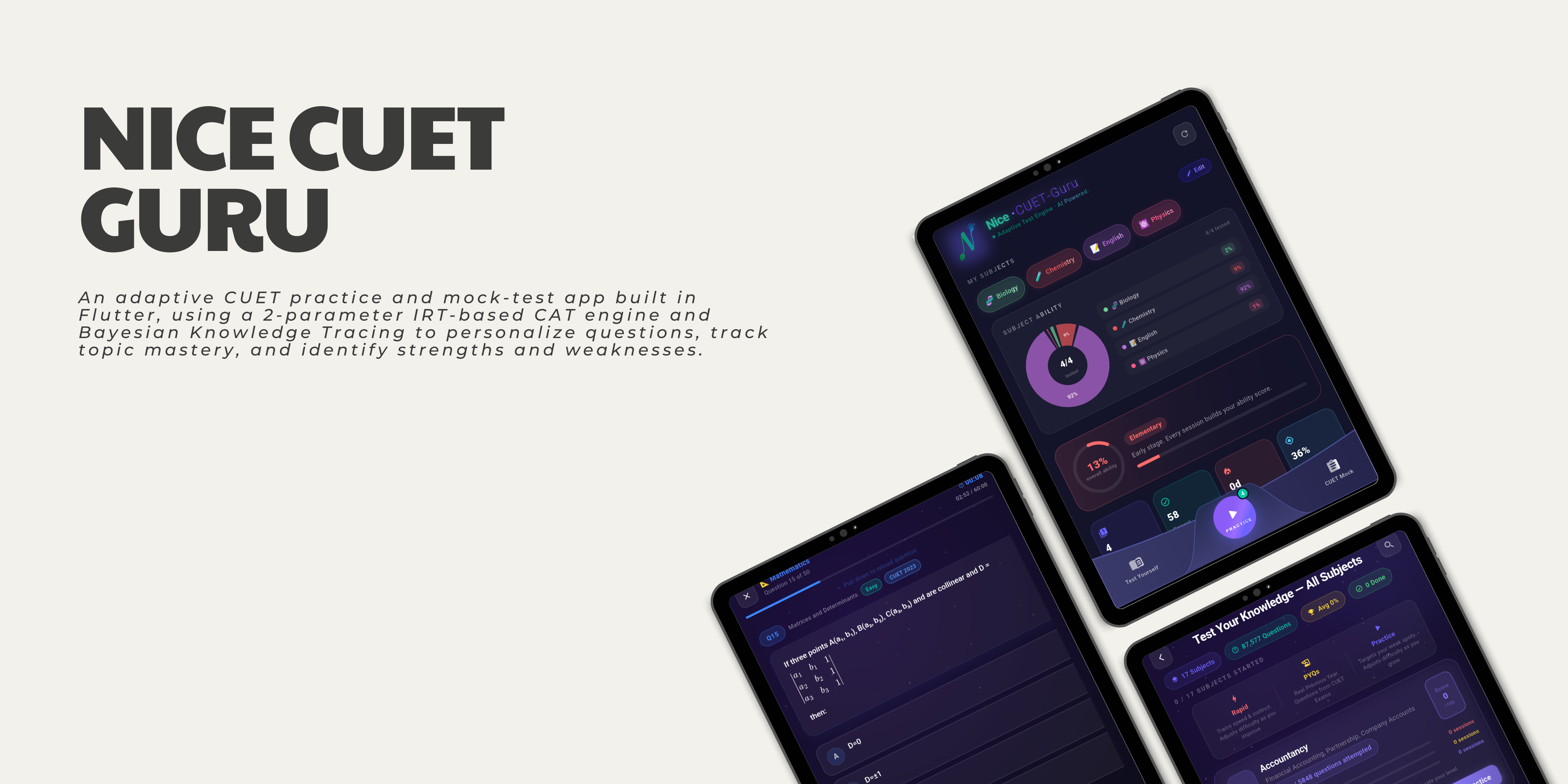
- Six Adaptive Test Modes – Interactive, Subject, CUET Mock, Weakness, Speed (Rapid), and PYQ sessions, all driven by the same CAT engine.
- IRT-Based Ability Estimation – Theta is re-estimated via EAP over an 81-point quadrature grid, not a simple right/wrong heuristic.
- Fisher-Information Question Selection – Picks the most informative question for a student's current ability, with topic cooldown for variety.
- Bayesian Knowledge Tracing – Maintains per-topic mastery probability, updated instantly after each response.
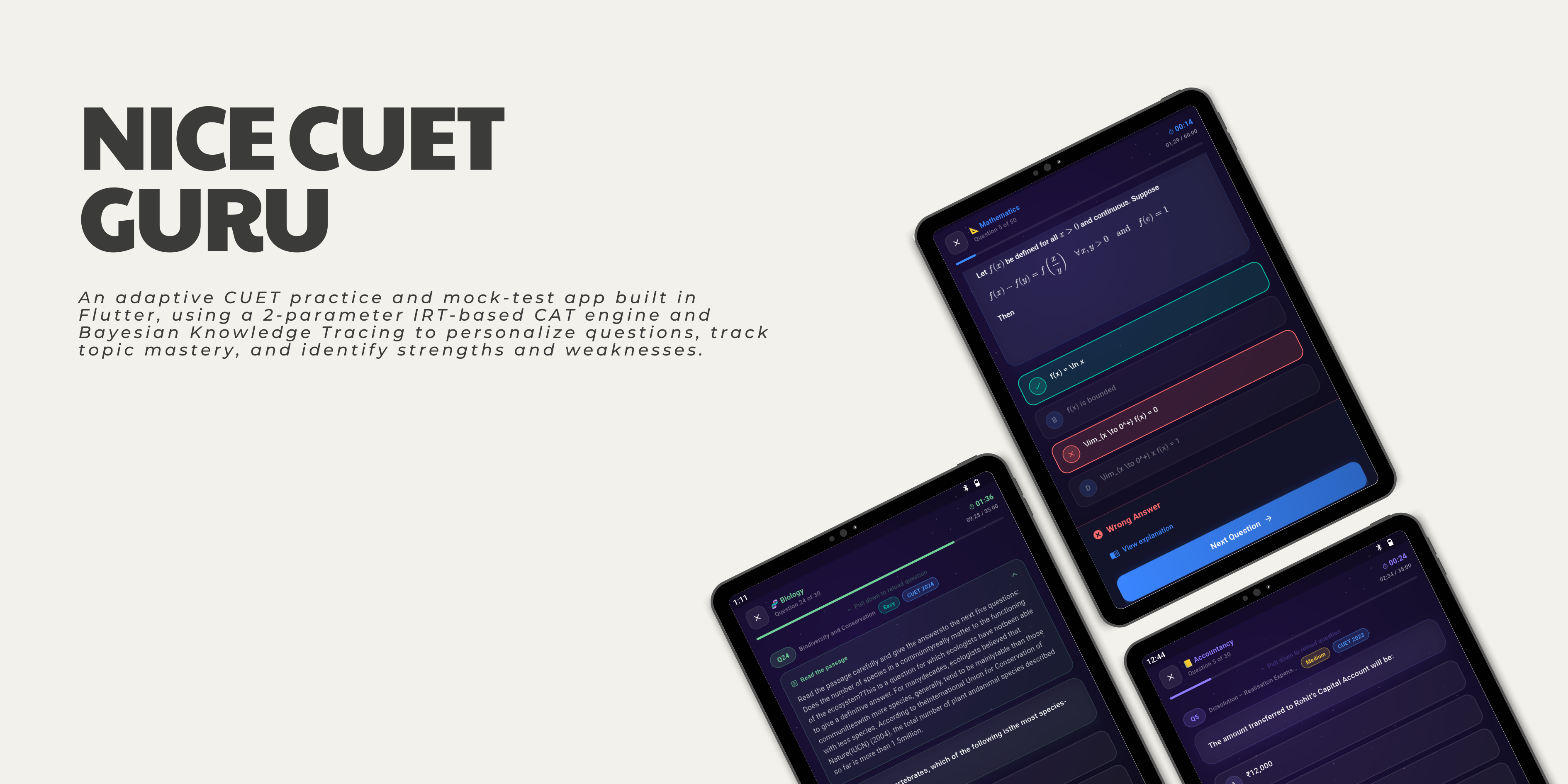
- CUET-Format Mock Tests – Section timers, NTA-style question palette, mark-for-review, and +5 / -1 / 0 marking.
- Exposure Cooldown – 14/30/60-day cooldowns by mode so the same question never reappears too soon.
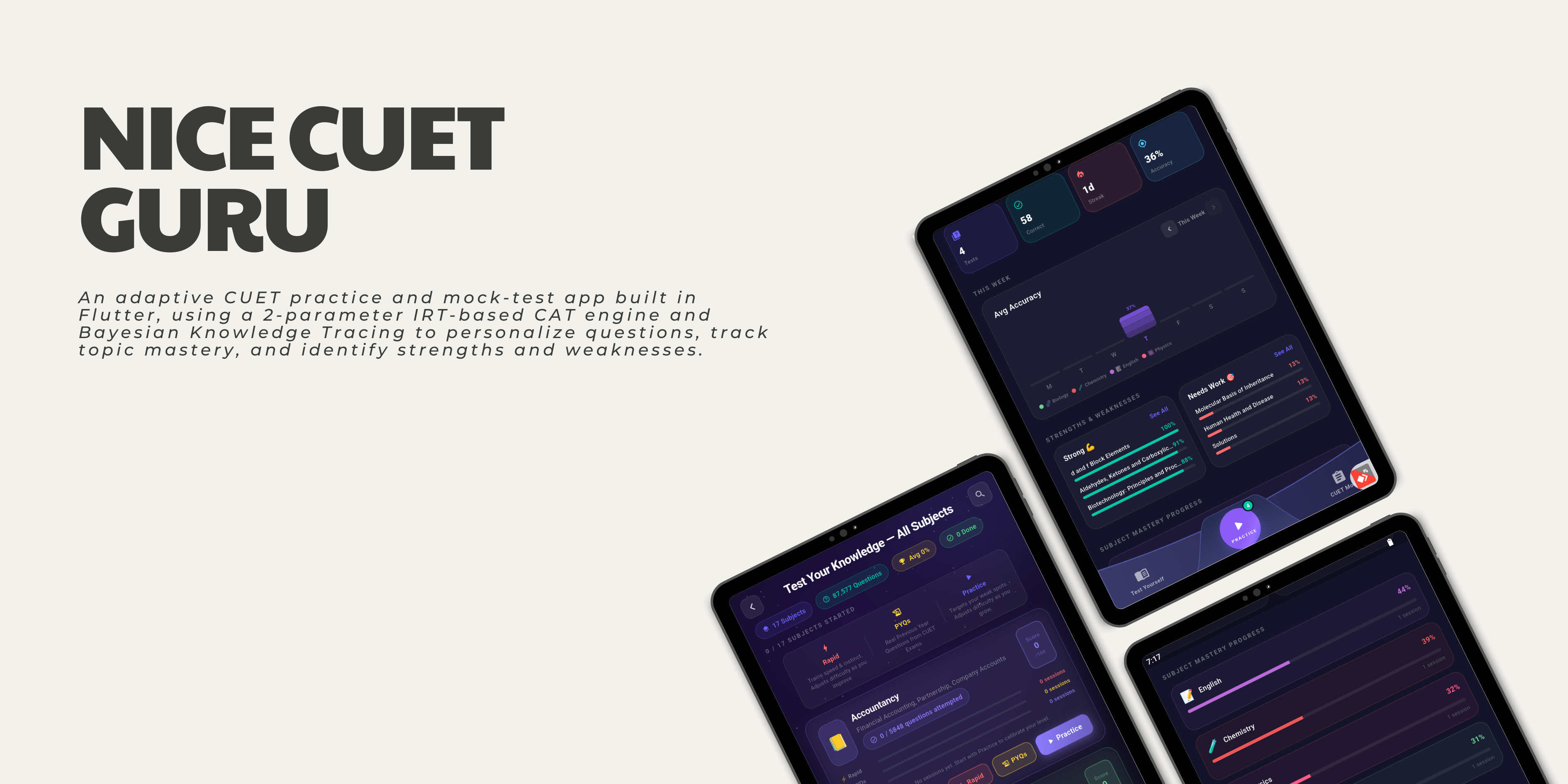
- Home Dashboard – Ability ring, weekly accuracy chart, strength/weakness panel, subject progress, and recent tests.
- Subject Mastery Bands – Mastered, Proficient, Developing, Weak, and Not Started, computed from live BKT probabilities.
- Atomic Passage Groups – Reading-comprehension passages are scheduled at fixed slots, with ability updated once per group, never mid-passage.
- Rich Content Rendering – LaTeX/MathJax rendering for math and science questions, with a pure-Flutter fallback.
- PYQ Bank – Previous-year CUET questions with their own 60-day exposure cooldown.
- Session Review & Analytics – Post-test breakdown by question outcome, per-topic accuracy, and total time.
Project Gallery ~
Nice CUET-Guru In Pictures